
Bulenox Review: Master, Momentum and Fast Track Compared
Affiliate disclosure: VTF may earn a commission if you purchase through the affiliate links in this review. That relationship does not change the rules described below. A referral code is not a promise of a discount; check the final order total and the terms for your exact plan.
Research checked October 6, 2026. This update uses the firm’s official pricing and help documents, with original payout calculations and AI-assisted research and drafting prepared for Verified Trader Funding. It is a desk-researched review, not a new firsthand trading or payout test. Examples are hypothetical, assume all other eligibility requirements are met, and exclude taxes and payment-provider charges. Futures trading involves risk; fees can be lost and payouts are conditional.
VTF verdict: Compare the exact program, not the brand-wide headline. Momentum and Fast Track offer distinct routes, while standard Master deserves extra scrutiny because its published post-payout consistency wording conflicts.
Bulenox has three distinct program families
The name Bulenox does not identify one payout policy. The standard Qualification-to-Master route, Momentum and Fast Track have different entry costs, drawdowns and payout conditions. A review that combines the easiest condition from each can describe an account you cannot actually buy. This review keeps those families separate and uses 50K examples.
| 50K route | Entry model | Important distinction |
|---|---|---|
| Qualification → Master | Evaluation followed by Master activation | Legacy-style Master withdrawal rules |
| Momentum | $143 published one-time entry; free Master activation | Evaluation followed by five qualifying-day payout cycles |
| Fast Track | $488 published one-time entry; no evaluation | Immediate simulated funded stage; tighter initial consistency |
Momentum and Fast Track prices are published standard amounts. The comparison does not assume a JKT discount. Official Momentum terms. Official Fast Track terms.
Standard Qualification and Master: read the reserve first
Standard Qualification has no minimum trading-day requirement. Positions must close before the session cutoff; overnight holding is prohibited. A $78 reset restores the Qualification account but does not extend its 30-day access period. The 50K Master activation is listed at $148. Verify the initial Qualification checkout price separately rather than combining an old promotional entry price with current Master terms. Qualification rules and reset terms. Master activation terms.
The standard Master policy requires ten trading days for each payout period, a $1,000 minimum request and 40% consistency. A 50K account must retain a $2,600 reserve above its starting balance. Its first three payouts are capped at $1,500 each; later requests remain subject to the other gates. Processing is weekly on Wednesday, with a Friday 11:59 p.m. CT submission cutoff for the following cycle. Official Master withdrawal rules.
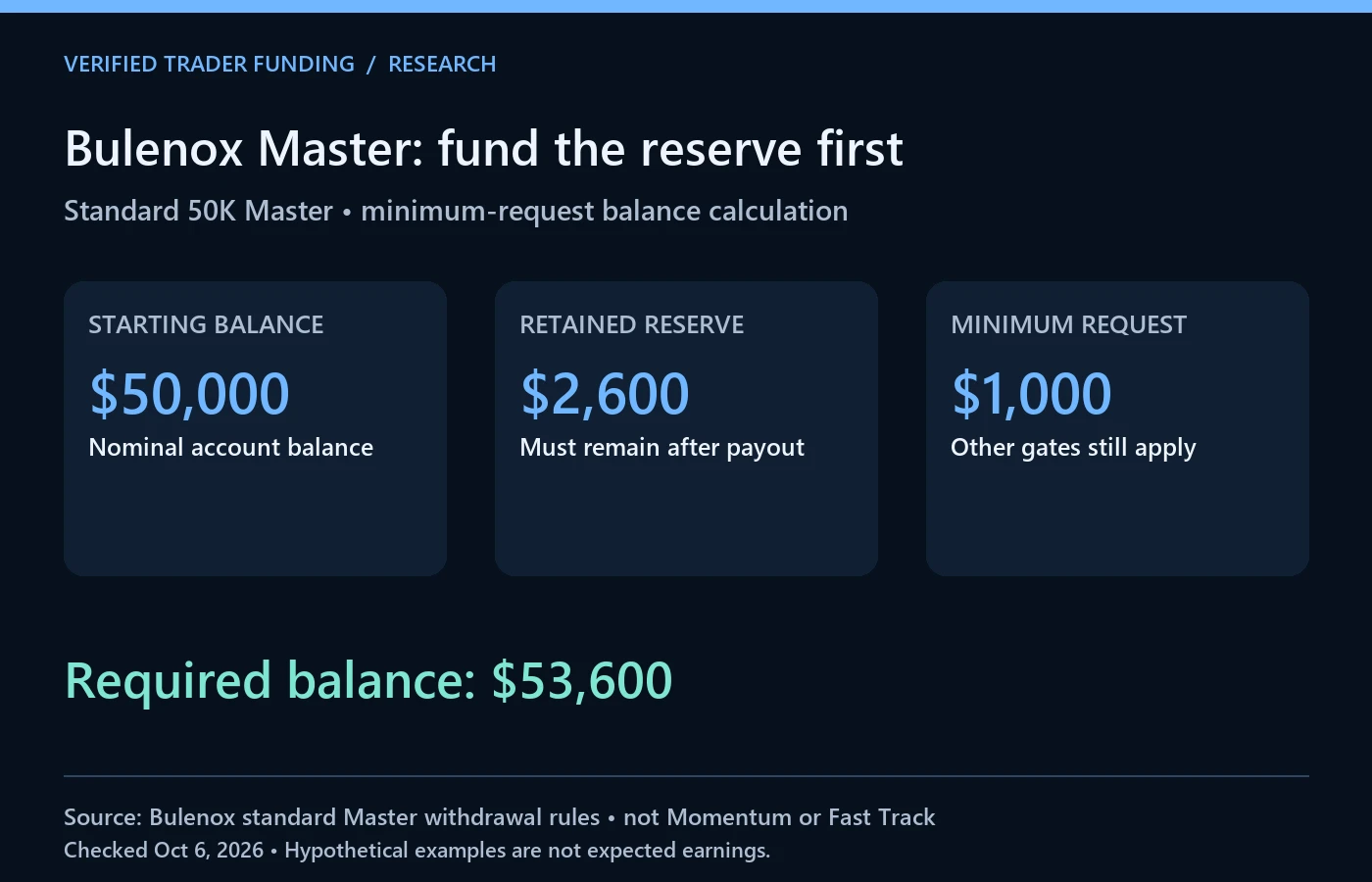
The arithmetic is straightforward but easy to miss: $50,000 + $2,600 retained reserve + $1,000 minimum request = $53,600. Reaching $52,600 fills the reserve; it does not create a $1,000 ordinary payout. A plan built around “reach the buffer, then withdraw it” would be using the wrong cash threshold.
An official Master consistency conflict remains unresolved
The Master help content says the best day does not reset and refers to accumulated profit across the trading period. It also says consistency resets after each payout and uses the new cycle. Those statements do not describe the same subsequent-payout calculation. We cannot resolve that conflict from the published text. Obtain written clarification for your account before planning a second withdrawal. Conflicting wording in the Master policy.
This is material because the denominator controls the amount of additional profit needed. If a previous large day remains in the numerator, your next cycle can behave differently from a clean reset. We therefore do not label standard Master as either a lifetime-consistency or cycle-only product. A support answer should identify your program, purchase date and exactly which dashboard fields enter the calculation.
Momentum: lower entry price, separate payout conditions
Momentum 50K lists a $3,000 evaluation target and $2,250 drawdown. Option 1 permits seven minis with trailing drawdown. Option 2 uses EOD drawdown, four minis and a $1,200 daily loss limit without scaling. The funded stage requires five days with at least $150 net profit, 35% cycle consistency and a $53,000 minimum payout balance. The minimum request is $1,000; published 50K caps progress through $1,500, $2,000, $2,500 and $3,000. Momentum parameters and payout rules.
A positive session and a qualifying session are different things. A $140 net day can improve the balance without advancing the five-day counter. Conversely, five $150 days create only $750 profit; the count alone does not meet the first withdrawal balance. Track the balance, qualifying days and consistency as separate conditions.
The Option 2 contract allowance is also a different product design from a larger advertised Option 1 maximum. Maximum contracts are a ceiling, not a suggested position size. A trader who expects to copy the same size across several accounts should check each account’s actual option before sending an order.
Fast Track: skipping the evaluation does not skip qualification for cash
Fast Track 50K lists a $2,250 drawdown. Option 2 has a $1,200 daily loss limit and four-mini maximum. There is no standalone minimum-day requirement, but consistency starts at 20%, then moves to 25% and 30% for later payouts. The first profit goal is $3,000; subsequent cycles require $2,000 of new profit. The minimum request is $1,000, with a $2,000 cap for the first three and $2,500 thereafter. Fast Track rules.
An original example shows the tradeoff: a $900 best day under a 20% limit requires $4,500 total cycle profit. That is $1,500 beyond a nominal $3,000 goal. The higher purchase price has removed the evaluation, not the need to demonstrate a particular profit distribution. Do not confuse a lack of minimum days with unrestricted payouts.
Fast Track and Master accounts share the first-$10,000 payout allowance at the trader-profile level; it is not a fresh allowance per account. The official structure pays that initial allowance at 100%, then applies a 90% trader share. Profile-level profit split.
Costs, platforms and the comparison that actually helps
The fixed $143 Momentum and $488 Fast Track entry prices differ by $345 before any applicable promotion. That difference buys a different route, not identical access at a higher speed. An evaluation failure and a funded-account failure also leave you in different positions. Compare the whole route you expect to use rather than assuming every purchase succeeds first time.
Bulenox’s Qualification help identifies a $100 monthly fee when connecting through certain third-party APIs or Trader Composite Software. Before using a copier or external connection, confirm whether your exact configuration triggers that charge. A data or software expense can outweigh a modest entry discount. Official third-party connection terms.
Reasons to shortlist: several entry models, an EOD option, and clearly distinct alternatives for traders willing to complete an evaluation or pay to skip it. Reasons to hesitate: multiple policy families invite accidental rule mixing; standard Master’s reserve and processing schedule slow cash access; the subsequent-consistency conflict needs clarification.
For a useful comparison, put the same sequence of daily profits into Bulenox Momentum and Tradeify Select Flex. Then compare standard Master with Apex’s six-payout EOD account. Include the retained reserve and account lifecycle, not just a cap labeled “up to.” Our payout-rules guide explains the difference between eligible balance, request amount and cash received.
Bulenox FAQ
Does the $2,600 standard Master reserve become a normal payout?
It must remain after an ordinary payout. Any account-termination treatment is a separate agreement issue; do not count it as available operating cash.
Are Fast Track and Momentum live brokerage accounts?
Do not equate “funded” or “no evaluation” with an immediately live account. These program comparisons concern the simulated funded stage and its contractual payout conditions.
Which Bulenox discount should I use?
VTF’s current configured code is JKT. We have not verified a current percentage or redeemed it at checkout; old JKT90 or JKT75 promotions should not be assumed to apply.
Before you buy
Open the Bulenox comparison profile and compare programs side by side. Check the dates on comparison snapshots: this review reflects the official documents checked above. Use our prop-firm selection guide to match the program to a process you already trade, then confirm eligibility, your platform/data costs, the account agreement, and the checkout total. Save the rules that apply to your purchase date.
View Bulenox plans through VTF’s affiliate link. VTF’s configured referral code is JKT; enter it only if the checkout provides a code field. No current discount percentage is assumed here.
Affiliate Disclosure: This post may contain affiliate links. If you sign up through our links, we may earn a commission at no extra cost to you. Each review explains its research method and evidence; affiliate compensation does not guarantee a favorable assessment.