
TradeDay Review: Quick Pay vs Fast Pass, Costs and Rules
Affiliate disclosure: VTF may earn a commission if you purchase through the affiliate links in this review. That relationship does not change the rules described below. A referral code is not a promise of a discount; check the final order total and the terms for your exact plan.
Research checked October 6, 2026. This update uses the firm’s official pricing and help documents, with original payout calculations and AI-assisted research and drafting prepared for Verified Trader Funding. It is a desk-researched review, not a new firsthand trading or payout test. Examples are hypothetical, assume all other eligibility requirements are met, and exclude taxes and payment-provider charges. Futures trading involves risk; fees can be lost and payouts are conditional.
VTF verdict: Choose the funded payout model first. Quick Pay’s flexible requests and Fast Pass’s EOD structure solve different problems, and neither should be judged by the headline split alone.
TradeDay Quick Pay versus Fast Pass
TradeDay should be reviewed as two different operating models. Quick Pay emphasizes flexible requests, but its cash split depends on how much profit remains in the account. Fast Pass uses a more structured payout cycle and an end-of-day funded drawdown. Comparing only evaluation prices can steer a trader toward the wrong funded program.
| 50K evaluation | Standard monthly price | Main distinction |
|---|---|---|
| Quick Pay Intraday | $131 | Intraday evaluation drawdown |
| Quick Pay EOD | $175 | EOD evaluation; funded Quick Pay still uses intraday drawdown |
| Fast Pass | $189 | EOD evaluation and funded model |
The published 50K routes use a $3,000 target and $2,000 drawdown. Promotional checkout amounts can be lower; the figures above are standard monthly prices, not KING discount promises. TradeDay plan comparison.
Evaluation consistency and the minimum-day confusion
Quick Pay uses a 30% evaluation consistency objective; Fast Pass uses 45%. A dominant best day can raise the profit needed beyond the advertised target. Official consistency objective.
For example, a $1,350 best day on Quick Pay implies $1,350 ÷ 0.30 = $4,500 total profit to meet the ratio. That is $1,500 beyond a nominal $3,000 target. If your strategy naturally produces occasional large days, this matters more than a small difference in the subscription price.
The newer Fast Pass explanation says there is no standalone minimum trading-day requirement. Its 45% consistency condition nevertheless makes a two-profitable-day pass mathematically impossible: one of two positive days must contribute at least 50%. Thus “no minimum” should not be read as a realistic one-day or two-day pass. Older wording describing three days should be understood against the newer explanation. Fast Pass explanation, updated September 9, 2026.
What changes when you become funded
Quick Pay funded accounts use intraday drawdown even if you purchased an EOD evaluation. Fast Pass funded accounts use EOD drawdown. Both remain subject to the firm’s permitted instruments, position limits and trading windows. Official funded rules.
EOD describes when a trailing threshold is calculated; it does not let you cross the threshold during the session. TradeDay explains that maximum drawdown is enforced in real time and eventually stops trailing at the starting balance. Official drawdown explanation.
This creates an important buying test. Replay several of your normal trades, including the largest unrealized gains that later retraced. Would those trades survive an intraday moving floor? If the answer differs from an EOD floor, paying less for Quick Pay EOD does not solve the funded-stage mismatch.
Quick Pay payout math: the split is not permanently unlocked
Quick Pay’s minimum request is $250. The trader receives 50% on withdrawals from the lower $4,000 profit band and 80% on the portion above it. A withdrawal crossing the boundary uses both rates. The calculation is account-specific and based on current profit, rather than a permanent upgrade achieved through cumulative past withdrawals. Official Quick Pay payout policy.
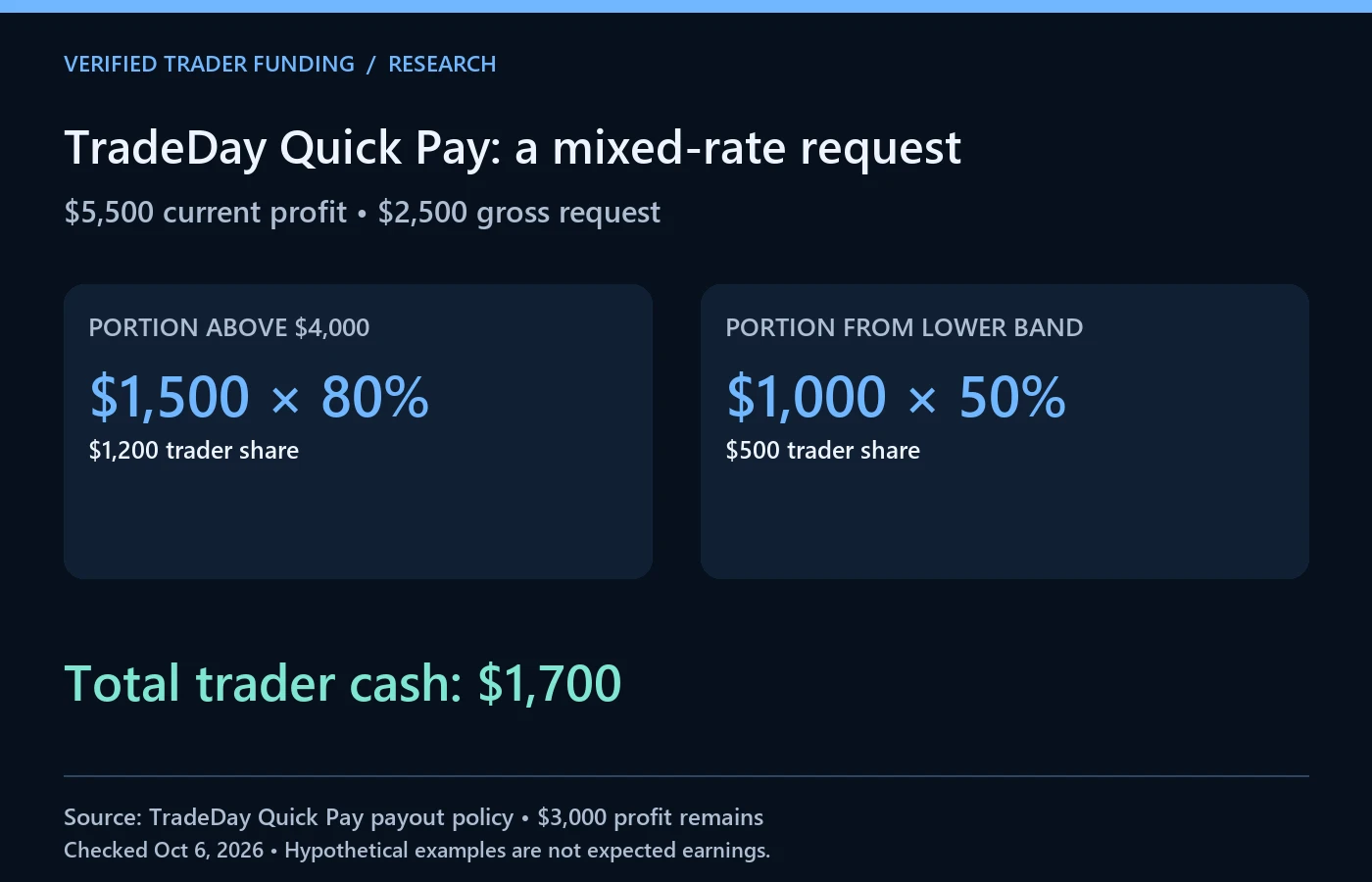
Consider $5,500 of current profit and a $2,500 gross request. The first $1,500 removed sits above the $4,000 boundary, producing $1,200 at an 80% share. The remaining $1,000 produces $500 at a 50% share. Total trader cash is $1,700, while $3,000 profit remains in the account. Multiplying the whole request by 80% would overstate the cash by $300.
Frequent small withdrawals are therefore not economically identical to allowing a larger balance to accumulate. That observation is not a recommendation to retain money at the firm: retained profit is still exposed to account rules and firm risk. It is a reason to compare cash received, rather than the largest headline split.
Fast Pass payout gates
For current 50K Fast Pass accounts, the official policy requires five qualifying days of at least $150, a $250 minimum request, an 80% trader share and 45% consistency. Requests are limited to 50% of the profit balance, with a $1,500 cap for the newer account cohort. Consistency uses the policy’s gross-profit measure, including withdrawals. Stop trading while a request is pending; the next cycle starts in the following eligible session after payout. Official Fast Pass payout policy.
With $2,000 current profit, the 50% balance rule limits the gross request to $1,000 even though the stated cap is $1,500. An approved $1,000 request yields $800 at an 80% share. At $4,000 profit, the 50% rule would allow $2,000, but the cap reduces that to $1,500, producing $1,200. All qualifying-day and consistency conditions still apply.
Live transitions and total cost
Quick Pay’s published route calls for review at $10,000 gross profit, including withdrawals; trading must stop at the threshold and excess profits can be forfeited. Review is a transition process, not a guarantee that every account will continue unchanged. Quick Pay route to live.
Fast Pass describes transition on the fifth payout request, potentially earlier, with new live-account conditions. Do not assume a simulated balance, position allowance or loss budget simply transfers dollar for dollar. Fast Pass route to live.
Monthly evaluations make elapsed time part of the cost. Two standard Quick Pay Intraday months total $262; two Fast Pass months total $378, before resets or any eligible discount. Compare the expected number of months under your normal process, not a best-case passing time. A cheaper first month can become an expensive mismatch if consistency or drawdown repeatedly forces a restart.
Who TradeDay suits, and who should compare alternatives
Quick Pay may suit a trader who accepts intraday risk controls and values flexible requests enough to accept the lower split on smaller balances. Fast Pass may suit a trader who prioritizes an EOD funded model and can work within qualifying-day, consistency and request-cap constraints.
Neither path is an obvious fit for someone who needs every profitable day to become immediately withdrawable at the highest advertised split. Compare Take Profit Trader’s retained buffer and Tradeify’s Select payout choices using the same hypothetical profit history. Our payout-rules guide provides a checklist for the conditions that headline splits leave out.
TradeDay FAQ
Does Quick Pay EOD stay EOD after passing?
No. The EOD label describes that evaluation option. Funded Quick Pay uses intraday drawdown; Fast Pass is the separate EOD funded route.
Is Fast Pass literally passable in one day?
The current description removes a standalone day minimum, but its 45% consistency objective prevents a one-day or two-day pass. Consistency is still a completion condition.
Has the KING discount been independently redeemed?
No purchase or coupon redemption was performed. Use the VTF affiliate link and verify the selected plan, renewal price and discount shown before paying.
Before you buy
Open the TradeDay comparison profile and compare programs side by side. Check the dates on comparison snapshots: this review reflects the official documents checked above. Use our prop-firm selection guide to match the program to a process you already trade, then confirm eligibility, your platform/data costs, the account agreement, and the checkout total. Save the rules that apply to your purchase date.
View TradeDay plans through VTF’s affiliate link. VTF’s configured referral code is KING; enter it only if the checkout provides a code field. No current discount percentage is assumed here.
Affiliate Disclosure: This post may contain affiliate links. If you sign up through our links, we may earn a commission at no extra cost to you. Each review explains its research method and evidence; affiliate compensation does not guarantee a favorable assessment.